
Beef Bone Broth
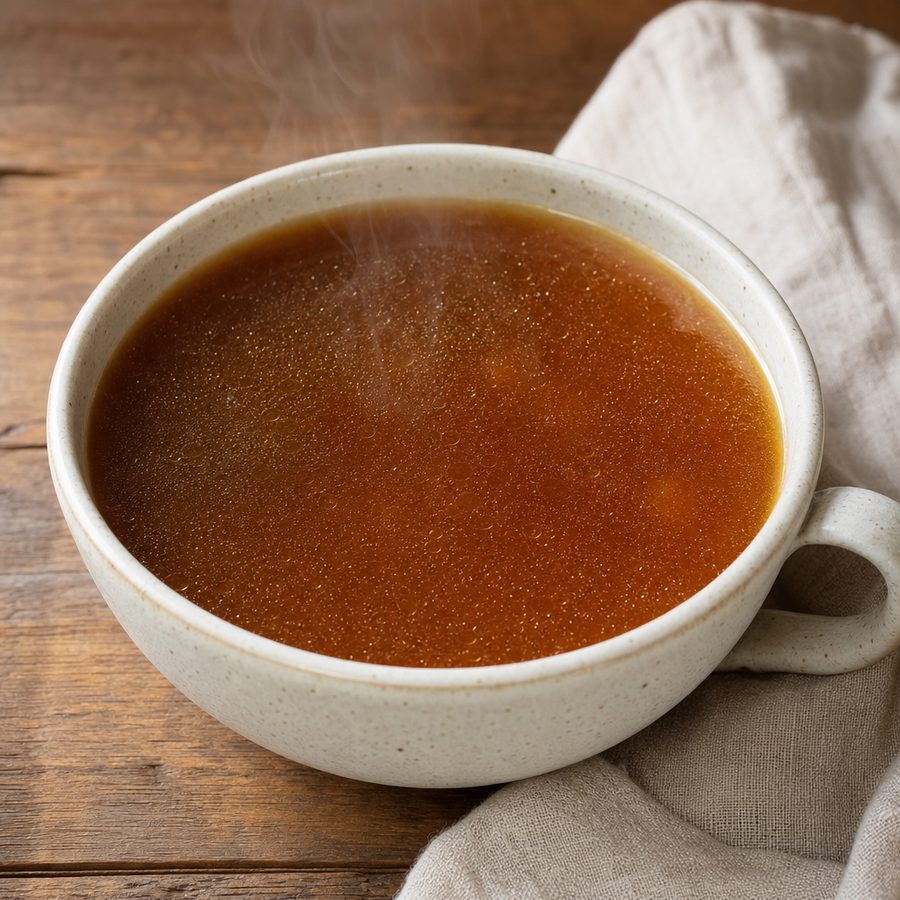
Beef knuckle and marrow bones roasted deep brown, then simmered with vegetables and herbs for most of a day into a dark, rich broth.
Why you'll love Beef Bone Broth
This is the broth in the bison and wild mushroom stew, the bo kho, the Jamaican oxtail, and the pan sauce for steak au poivre. Roasting the bones first is what gives it its color and depth: the meat and marrow clinging to them brown in the oven the way a steak browns in a skillet, and that browned flavor carries into every recipe it goes into.
Beef bones are dense, so they need a long, slow simmer, ten to twelve hours, for their collagen to melt into gelatin. Knuckle bones are full of cartilage and bring the body; marrow bones bring richness. A broth made this way reduces into a glossy, spoon-coating pan sauce, which is exactly what the steak au poivre asks of it.
Start it in the morning and strain it in the evening. The pot needs only a check now and then to top up the water.
Quick overview: This Beef Bone Broth takes 15 min of hands-on time and about 12 hr 15 min in all and makes 10 servings, each 1 cup. You'll need a pot, a sheet pan, and a fine sieve.
Ingredients
- about 4 1/2 lb beef bones, a mix of knuckle, marrow, and neck bones
- 2 tbsp tomato paste Label: tomatoes, and salt if any
- 1 large onion, unpeeled and quartered
- 2 carrots, cut into chunks
- 3 celery ribs, cut into chunks
- 1 head garlic, halved crosswise
- about 4 1/2 quarts cold water, plus more as needed
- 2 bay leaves
- 1 tsp black peppercorns
- 4 sprigs fresh thyme
- 1 1/2 tsp fine sea salt, or to taste
Instructions
- Roast the bones: Heat the oven to 425°F (220°C). Spread the bones on a large rimmed sheet pan in one layer and roast for 30 minutes, until they start to brown.
- Add the tomato paste and vegetables: Turn the bones and brush the tomato paste over them, then scatter the onion, carrot, celery, and garlic around them. Roast for 20 to 30 minutes more, until the bones are deep brown and the paste has darkened to brick red. Watch the last few minutes, because dark brown gives a rich broth and blackened gives a bitter one.
- Deglaze the pan: Move the bones and vegetables to a stockpot of at least 8 quarts. Pour 1 cup of the water onto the hot sheet pan and scrape up the browned bits with a spatula, then pour it all into the pot. Those bits are concentrated flavor.
- Cover and skim: Add the rest of the cold water, enough to cover the bones by about an inch, with the bay leaves, peppercorns, and thyme. Bring it slowly to a simmer over medium heat and skim off the foam that rises in the first 30 minutes.
- Simmer all day: Lower the heat until only a few small bubbles break the surface, set the lid ajar, and simmer for 10 to 12 hours. Check every hour or two and add hot water if the bones start to show. The long, gentle simmer is what melts the collagen in the knuckles into gelatin.
- Strain: Set a fine sieve over a large bowl or a second pot, line it with damp cheesecloth for the clearest broth, and ladle the broth through without pressing on the solids. Discard the bones and vegetables. If any marrow is left in the bones, scoop it out and stir it into the broth or spread it over roasted vegetables. Stir in the salt and taste.
- Cool it fast: Set the pot or bowl of strained broth in a sink filled with ice water and stir it every few minutes, adding ice as it melts, until the broth is cool to the touch, or divide it among several smaller containers. Moving it quickly through the warm range is what keeps it safe.
- Chill and portion: Refrigerate the broth in containers no deeper than about 2 inches until it is cold and set. Lift off the firm layer of fat, then portion the broth into 1-cup, 2-cup, 3-cup, and 4-cup containers, the amounts the recipes on this site use.
Storage and leftovers
Cool the broth quickly. Food-safety guidance for cooked food is to bring it from hot to 70°F (21°C) within 2 hours and on down to 41°F (5°C) within the next 4 hours, and a full stockpot left to cool on its own holds its heat in the center far longer than that. Set the pot of strained broth in a sink of ice water and stir it every few minutes, or ladle it into several smaller containers, until it feels cool to the touch. Then refrigerate it, uncovered or loosely covered until cold, in containers no more than about 2 inches deep so the cold reaches the middle.
Refrigerate the cold broth in covered containers for up to 4 days. Freeze it for up to 3 months for the best flavor, leaving about an inch of space at the top of each container because broth expands as it freezes. Thaw it overnight in the refrigerator, or set the frozen block in a pot over low heat.
Bring refrigerated or thawed broth to a full boil before you drink it or use it, the standard guidance for reheating any broth, soup, or sauce.
Variations
- With oxtail: Swap a pound of the bones for oxtail. It brings more meat and gelatin, and the tender meat can be pulled off after 4 hours and saved for soup.
- Lemongrass and star anise: For the bo kho, add 2 bruised stalks of lemongrass and 2 whole star anise for the last 2 hours of simmering.
- Mushroom: Add a handful of mushroom stems or 1 tablespoon of dried mushroom powder with the water for an earthier broth to go with the bison stew.
- Slow cooker: Roast the bones and vegetables as written, then put everything in a large slow cooker, cover with water, and cook on low for 12 hours before straining.
Notes and tips
- Ask the butcher: Ask for knuckle and marrow bones cut into 2- to 3-inch pieces. Smaller pieces expose more marrow and cartilage and fit the pot better.
- Simmer during the day: Plan the simmer for daytime hours so the pot is never left on the stove overnight or while you are out.
- Save the fat: Lift the chilled fat off in one piece, refrigerate it in a covered container, and use it within 4 days to roast vegetables.
- Check the tomato paste label: It should list tomatoes, and salt if any.
Nutrition and mindful eating
- Knuckle bones are full of cartilage, and a long simmer turns its collagen into gelatin, which is what gives this broth its body and makes it reduce into a glossy sauce.
- Marrow is mostly fat, and a little of it melting into the pot gives the broth a rounder, richer taste.
- Roasting the bones and tomato paste first browns them, and those browned flavors give the broth its deep color and savory taste with nothing added beyond bones, vegetables, herbs, and salt.
- As you eat, notice the depth this broth brings to a stew or pan sauce, and pay attention to how a meal built on it leaves you warm and settled, and how long that lasts.
Frequently asked questions
Have a question about this Beef Bone Broth? Start here, with the questions people ask most.
Why roast the bones first?
Browning the meat and marrow on the bones builds the deep, roasted flavor and dark color. Bones simmered raw give a lighter, milder broth.
Where do I find beef bones?
At the butcher counter, at farmers markets, and in the freezer case of many grocery stores, often labeled soup bones or marrow bones.
What if my broth stays liquid in the refrigerator?
It is still good to use. Next time, use more knuckle bones, start with a little less water, and give it the full 12 hours at a gentle simmer.
Can I use store-bought bone broth in the recipes instead?
Yes. Choose one whose label lists beef bones, water, vegetables, herbs, and salt, with no sugar, natural flavors, or oil.
You might also like
Start with the free guide
The RESET360 starter guide walks you through the plate, the daily rhythm, and your first week, sent straight to your inbox.