
Herb-Roasted Cornish Hens with Lemon
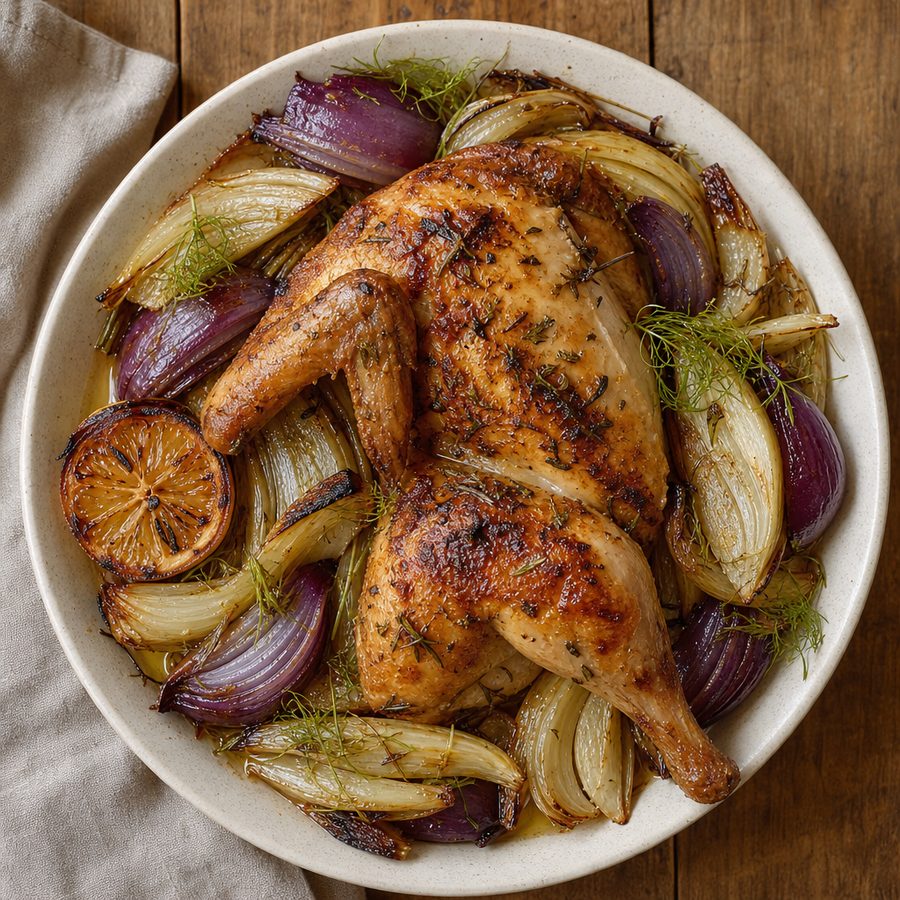
Cornish hens roasted with garlic herb butter under the skin over fennel and red onion, finished with roasted lemon squeezed into the pan juices.
Why you'll love Herb-Roasted Cornish Hens with Lemon
Cornish hens are small enough that each one serves two, and they look like a celebration on the platter. Here they get the treatment of a holiday roast chicken in under an hour: butter mashed with garlic, thyme, rosemary, parsley, and lemon zest is pushed under the skin, the cavities are filled with lemon and herb sprigs, and the birds roast on a bed of fennel and red onion that soaks up every drop of what drips down. In November, when the table feels like it should be a little special, this is the bird for a smaller gathering.
Putting the butter under the skin is the technique that matters. Butter spread on top mostly runs off, but butter tucked against the meat bastes the breast from the inside as it melts, keeping it moist while the skin above it dries and crisps. The lemon halves roast cut side down in the pan until they caramelize, and squeezing that warm, mellow juice over the hens at the end gives you a pan sauce with no extra work.
Half a hen with a pile of roasted fennel is a complete plate. Add mashed cauliflower or a green salad and dinner is done.
Quick overview: This Herb-Roasted Cornish Hens with Lemon takes 20 min of hands-on time and about 1 hr 15 min in all and makes 4 servings, each 1/2 hen with vegetables and pan juices. You'll need a sheet pan.
Ingredients
- 2 Cornish hens (about 1 1/2 lb each), thawed if frozen, giblets removed
- 1 1/4 tsp fine sea salt, divided
- 1/2 tsp freshly ground black pepper
- 4 tbsp butter, softened
- 3 cloves garlic, finely grated
- 1 tbsp chopped fresh thyme, plus 4 sprigs
- 2 tsp finely chopped fresh rosemary, plus 2 small sprigs
- 2 tbsp chopped parsley
- finely grated zest of 1 lemon
- 2 lemons (including the zested one), halved
- 2 medium fennel bulbs, trimmed and cut into 1-inch wedges, a few fronds saved
- 1 large red onion, cut into 8 wedges
- 1 tbsp olive oil
- 1/4 cup chicken bone broth Label: chicken bones, water, vegetables, herbs, and salt, with no sugar, natural flavors, or oil
Instructions
- Dry and season the hens: Heat the oven to 425°F (220°C). Pat the hens very dry inside and out with paper towels and season the cavities with 1/4 teaspoon of the salt. Dry skin is what lets the oven crisp it; any water on the surface has to steam away first.
- Make the herb butter: Mash the softened butter with the garlic, chopped thyme, chopped rosemary, parsley, lemon zest, 1/2 teaspoon of the salt, and the pepper until evenly mixed.
- Butter under the skin: Starting at the cavity end, slide your fingers gently between the skin and the breast meat of each hen to loosen it, working over the breast and down toward the thighs without tearing. Push about two thirds of the herb butter under the skin and press from the outside to spread it evenly, then rub the rest over the outside. Tuck one lemon half and two thyme sprigs and a rosemary sprig into each cavity and tie the legs together with kitchen string so the birds cook evenly.
- Set up the pan: Toss the fennel and onion with the olive oil and the remaining 1/2 teaspoon of salt on a large rimmed sheet pan and spread them out. Set the hens on top, breast side up, with space between them, and lay the remaining two lemon halves cut side down on the pan.
- Roast: Roast for 45 to 60 minutes, until the skin is deep golden, the juices run clear, and an instant-read thermometer in the thickest part of the thigh, away from the bone, reads 165°F (74°C). If the skin browns before the hens are done, lay a sheet of foil loosely over the top for the last 10 minutes.
- Rest: Move the hens to a cutting board and let them rest for 10 minutes. Resting lets the juices settle back into the meat, so they stay in the hen when you cut it instead of running onto the board.
- Make the pan juices: While the hens rest, squeeze the roasted lemon halves from the pan over the vegetables, pour in the broth, and scrape up the browned bits with a spatula so they dissolve into the juices. Taste and add salt if needed.
- Split and serve: Snip out the string and cut each hen in half lengthwise with kitchen shears or a heavy knife, cutting along one side of the backbone and then through the breastbone. Serve each half over the fennel and onions with the pan juices spooned over and a few fennel fronds on top.
Storage and leftovers
Refrigerate leftover hen and vegetables in a sealed container within 2 hours of cooking and eat within 3 to 4 days.
Reheat in a 350°F (175°C) oven, covered loosely with foil, for 15 to 20 minutes, until hot through to 165°F (74°C). Pulled from the bone, the meat also freezes for up to 3 months.
Variations
- Orange and sage: Use orange zest and orange halves in place of the lemon and chopped sage in place of the rosemary.
- Spatchcocked: Cut out the backbones with kitchen shears and press the hens flat before buttering. They roast in 35 to 45 minutes.
- Leeks and radishes: Roast the hens over sliced leeks and halved radishes in place of the fennel and onion.
- Garlic heads: Halve a whole head of garlic crosswise and roast it cut side down on the pan, then squeeze the soft cloves into the pan juices.
Notes and tips
- Salt them ahead: For the crispest skin, season the hens with the salt a day ahead and refrigerate them uncovered on a rack. The salt seasons the meat and dries the skin.
- Thaw safely: Most Cornish hens are sold frozen. Thaw them in the refrigerator for 1 to 2 days, never on the counter.
- Use soft butter: Butter at room temperature spreads under the skin without tearing it. Cold butter tears the skin and sits in lumps.
- Check the thigh: The thigh is the last part to finish. Measure there, away from the bone, and the breast will be done too.
Nutrition and mindful eating
- Cornish hens bring protein along with niacin, vitamin B6, and selenium, and half a hen is a satisfying portion of both breast and dark meat.
- The herb butter and the skin it crisps are the real fat on this plate, which carries the garlic and herbs and makes the meal deeply satisfying.
- Fennel roasts sweet and tender, and with the onion it brings fiber and potassium to the plate.
- Roasted lemon adds brightness to the juices, which is often all a plate of roast bird and vegetables needs.
- As you eat, notice the crisp skin against the soft fennel and the lift of the lemon, and pay attention to how full you feel through the evening: this dinner should hold you well past 3 hours, until breakfast if you let it.
Frequently asked questions
Have a question about this Herb-Roasted Cornish Hens with Lemon? Start here, with the questions people ask most.
What is a Cornish hen?
A small, young chicken, usually 1 to 2 pounds, with tender meat and a high proportion of skin. Look for them in the freezer case or at the butcher counter.
Do I have to truss them?
Tying the legs keeps the thighs close to the body so the birds cook evenly and look neat, but untied hens roast fine too. Check the thighs for 165°F (74°C) either way.
Can I use a whole chicken?
Yes. Use a 4 lb chicken with all of the herb butter and roast it at 425°F (220°C) for 60 to 80 minutes, until the thigh reads 165°F (74°C).
Can I prepare them ahead?
Butter the hens and refrigerate them, covered, up to a day ahead. Let them sit out for 20 minutes before roasting so they cook evenly.
You might also like
Start with the free guide
The RESET360 starter guide walks you through the plate, the daily rhythm, and your first week, sent straight to your inbox.