
Orange Almond Olive Oil Cake
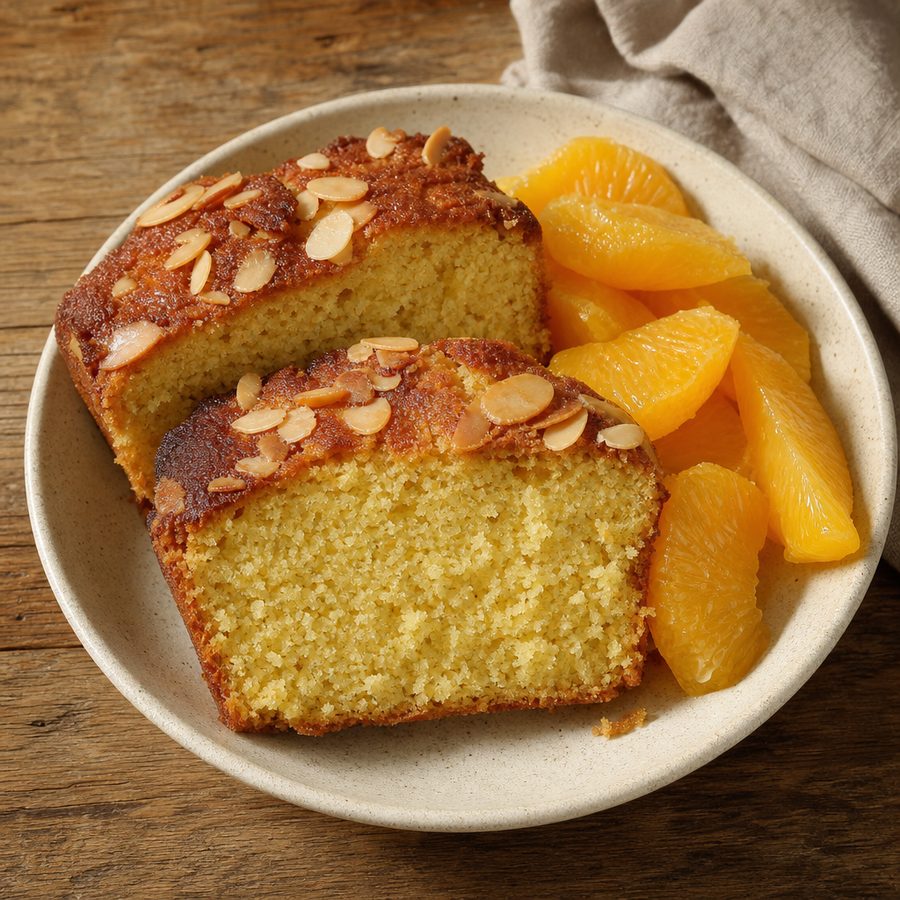
A moist, tender almond flour loaf cake with olive oil, Greek yogurt, and lots of orange zest, served with fresh orange segments.
Why you'll love Orange Almond Olive Oil Cake
Winter is citrus season, when navel oranges, Cara Caras, and blood oranges fill the markets, and this cake is made to show them off. Almond flour gives it a moist, tender crumb, extra-virgin olive oil gives it a fruity richness and keeps it soft for days, and two whole oranges' worth of zest perfume every slice. A plate of fresh orange segments on the side makes it feel bright and light after a heavy winter dinner.
Almond flour is finely ground almonds, and it bakes into a denser, moister crumb than wheat flour, so the cake gets its lift from two places. The eggs are beaten with the allulose until pale and thick, which traps air, and a little baking soda reacts with the tang of the Greek yogurt and lemon juice to make more bubbles in the oven. Rubbing the zest into the allulose before mixing releases the orange oils, so the flavor runs all the way through.
Allulose browns faster than sugar, so the cake bakes at a moderate 325°F and gets a loose tent of foil partway through. That gives the center time to set while the top turns deep golden. Like most olive oil cakes, it tastes even better the next day.
Quick overview: This Orange Almond Olive Oil Cake takes 20 min of hands-on time and about 1 hr 15 min in all and makes 10 servings, each 1 slice with orange segments. You'll need a loaf pan and a hand or stand mixer.
Ingredients
- 1/2 cup extra-virgin olive oil, plus a little for the pan
- 2 cups almond flour
- 1/2 tsp baking soda Label: sodium bicarbonate, and nothing else
- 1/4 tsp fine sea salt
- 1/2 cup allulose Label: allulose, and nothing else
- 2 tbsp finely grated orange zest (from 2 large oranges)
- 4 large eggs, at room temperature
- 1/2 cup plain whole-milk Greek yogurt, at room temperature
- 1 tbsp fresh lemon juice
- seeds from 1/2 vanilla bean
- 1/4 cup sliced almonds
- the 2 zested oranges, peeled and segmented, to serve
Instructions
- Prepare the pan: Heat the oven to 325°F (165°C). Brush a 9-by-5-inch loaf pan with olive oil and line it with a strip of parchment that hangs over the two long sides, so you can lift the cake out cleanly.
- Mix the dry ingredients: Whisk the almond flour, baking soda, and salt in a bowl, pressing out any lumps of almond flour with the back of a spoon.
- Rub the zest into the allulose: In a large bowl, rub the allulose and orange zest together with your fingertips for about 1 minute, until the allulose is damp and smells strongly of orange. The grains scrape the zest and pull its oils out.
- Beat the eggs: Add the eggs to the orange allulose and beat with a hand mixer on medium-high, or whisk hard by hand, for 3 to 4 minutes, until pale, thick, and almost doubled. The air beaten in here is much of what lifts the cake.
- Add the wet ingredients: With the mixer on low, pour in the olive oil in a slow stream, then beat in the yogurt, lemon juice, and vanilla seeds just until smooth.
- Fold in the almond flour: Add the dry ingredients and fold them in with a spatula until no dry streaks remain, keeping as much air in the batter as you can. The acid in the yogurt and lemon starts the baking soda working as soon as they meet, so get the cake into the oven right away.
- Bake: Scrape the batter into the loaf pan, smooth the top, and scatter the sliced almonds over it. Bake for 50 to 60 minutes, laying a loose sheet of foil over the top after 30 minutes, until the top is deep golden, the center springs back when pressed, and a toothpick pushed into the middle comes out clean.
- Cool: Let the cake cool in the loaf pan for 20 minutes, then lift it out by the parchment and cool it completely on a rack. Almond flour cakes are tender while warm and firm up as they cool, so a full cool gives clean slices.
- Serve: Cut into 10 slices and serve each with a few fresh orange segments.
Storage and leftovers
Keep the cake wrapped at room temperature for up to 1 day, or refrigerated for up to 5 days. Bring refrigerated slices to room temperature for 20 minutes before serving, since the olive oil firms in the cold.
Freeze slices individually wrapped for up to 2 months and thaw them at room temperature for an hour. Segment the oranges fresh when you serve.
Variations
- Blood orange: Use blood orange zest and serve with blood orange segments for a deep red plate in January and February.
- Lemon: Use lemon zest in place of the orange and serve with fresh raspberries.
- Cardamom: Whisk 1/2 teaspoon of ground cardamom into the almond flour; it pairs beautifully with orange.
- With cream: Serve each slice with a spoonful of whipped cream or whole-milk Greek yogurt alongside the oranges.
Notes and tips
- Zest before you peel: Zest the oranges first, while they are whole and firm, then cut away the pith and segment them for serving.
- Use a fruity olive oil: A mild, fruity extra-virgin olive oil makes a softer, rounder cake. A very peppery oil comes through strongly.
- Use blanched almond flour: Finely ground blanched almond flour gives the lightest crumb. Almond meal, made with the skins, bakes denser and darker.
- Level the baking soda: Level the half teaspoon with the back of a knife. Extra baking soda leaves a soapy taste.
Nutrition and mindful eating
- Almond flour brings protein, fiber, vitamin E, and magnesium, and it gives the cake a satisfying density that makes one slice feel like enough.
- Eggs and Greek yogurt add more protein, and extra-virgin olive oil is the real fat, which together slow how quickly the cake reaches your bloodstream.
- Oranges are a low-glycemic citrus, and here they are eaten whole, with their fiber, alongside the protein and fat in the cake. Orange zest carries the fruit's fragrant oils.
- Allulose gives the cake its sweetness and has very little effect on blood sugar.
- As you eat, notice the orange in each bite and the moist, rich crumb, eat slowly, and pay attention to how one slice with fresh fruit leaves you satisfied, without a pull toward a second piece later.
Frequently asked questions
Have a question about this Orange Almond Olive Oil Cake? Start here, with the questions people ask most.
Why does the cake brown so quickly?
Allulose browns at a lower temperature than sugar. The moderate oven and the foil tent let the center set while the top turns golden.
Can I bake it in a round pan?
Yes. Use a 9-inch round pan lined with parchment and start checking it at 35 minutes, since a shallower cake bakes faster.
Can I use a different oil?
Avocado oil works and gives a milder cake. Olive oil is what gives this one its fruity, almost peppery richness.
Can I make it dairy-free?
Use 1/2 cup of full-fat canned coconut milk, with a label of coconut and water, plus 1 extra teaspoon of lemon juice in place of the yogurt.
You might also like
Start with the free guide
The RESET360 starter guide walks you through the plate, the daily rhythm, and your first week, sent straight to your inbox.