
Soft Scrambled Eggs with Flaked Salmon and Chives
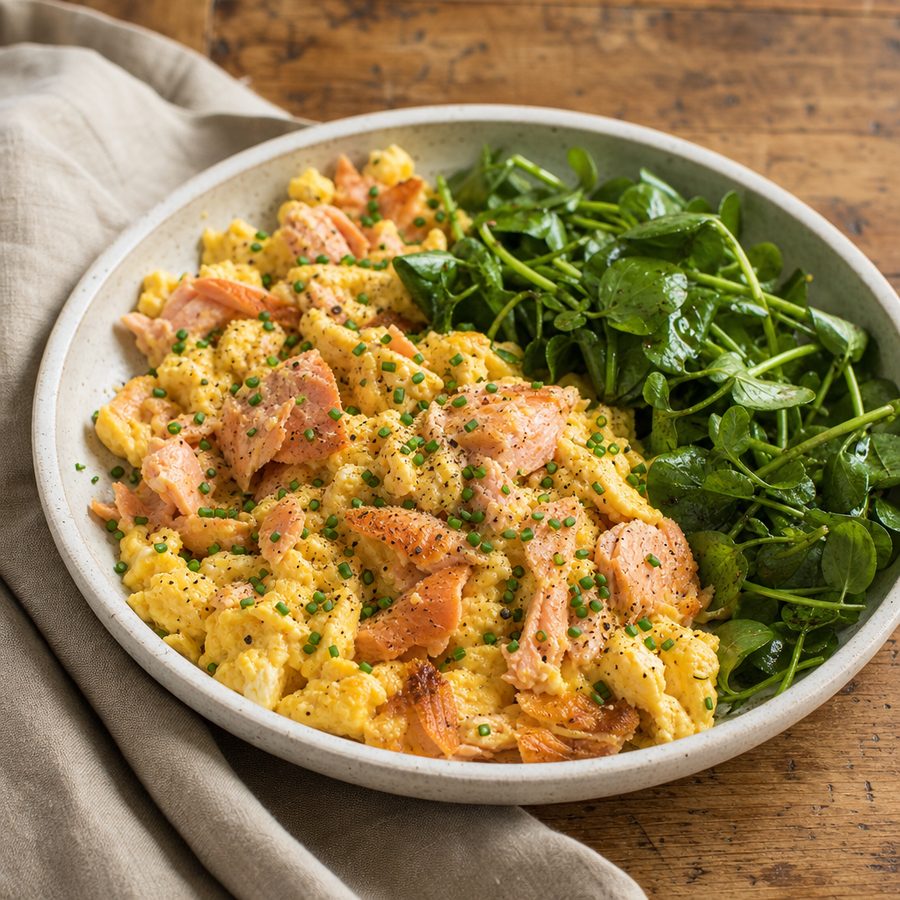
Eggs stirred slowly over low heat into soft, creamy curds, folded with flakes of roasted salmon and chives and served over lemony watercress.
Why you'll love Soft Scrambled Eggs with Flaked Salmon and Chives
This is the slow breakfast for a dark winter weekend. Eggs cook gently in butter while you stir, so they set into small, soft curds that stay glossy and custardy, and then big flakes of salmon roasted at home go in at the end with a spoonful of sour cream and a handful of chives. It eats like something from a good brunch place and comes together in about fifteen minutes once the fish is cooked.
Low heat is the whole technique. Egg proteins tighten as they warm, and when they heat slowly they set into a fine, tender web that holds its moisture, while high heat tightens them so fast they squeeze out water and turn rubbery. Taking the pan off the heat while the eggs still look slightly underdone lets the heat already in them finish the job, and the cold sour cream stirred in last stops the cooking right where you want it.
Roasting the salmon plain, with only salt and a little oil, keeps its flavor clean and its flesh moist, so it breaks into tender flakes that warm through in the eggs without cooking further. Roast an extra fillet with Sunday dinner and this breakfast is ten minutes on any morning of the week.
Quick overview: This Soft Scrambled Eggs with Flaked Salmon and Chives takes 10 min of hands-on time and about 30 min in all and makes 4 servings, each 2 eggs with salmon and greens. You'll need a skillet and a sheet pan.
Ingredients
- 8 oz skin-on salmon fillet (or about 1 1/2 cups flaked leftover roasted salmon)
- 1 tbsp plus 1 tsp olive oil, divided
- 1/2 tsp fine sea salt, divided
- 1/2 tsp finely grated lemon zest
- 8 large eggs
- 2 tbsp butter
- 2 tbsp full-fat sour cream, cold Label: cream and cultures
- 2 tbsp finely chopped chives, divided
- 2 large handfuls watercress (about 3 oz), thick stems trimmed
- 2 tsp fresh lemon juice
- freshly ground black pepper
Instructions
- Roast the salmon: Heat the oven to 400°F (200°C) and line a small sheet pan with parchment. Set the salmon skin side down on the pan, rub the top with 1 teaspoon of the olive oil, and season it with a pinch of the salt. Roast for 10 to 12 minutes, until the flesh flakes easily with a fork and reads 145°F (63°C) in the thickest part. A moderate oven cooks the fillet evenly so the edges stay as moist as the center.
- Flake the fish: Let the salmon cool for 5 minutes, then lift the flesh off the skin with a fork and break it into large flakes, checking for pin bones. Toss the flakes with the lemon zest. Big flakes hold together when they are folded into the eggs; small ones disappear into the curds.
- Whisk the eggs: Crack the eggs into a bowl, add 1/4 teaspoon of the salt, and whisk for a full 30 seconds, until the yolks and whites are one even color with no streaks of white. Salting the eggs before they cook helps the proteins hold on to their moisture, so the curds stay tender.
- Cook low and slow: Melt the butter in a nonstick skillet over low heat until it foams gently. Pour in the eggs and stir constantly with a silicone spatula, sweeping the bottom and sides of the pan, for 5 to 7 minutes. Small, soft curds will form slowly and the eggs will thicken into a creamy mass. If the curds start to form quickly or the pan sizzles, lift it off the heat for a few seconds, then go back.
- Finish off the heat: When the eggs are set into soft curds with no runny liquid left but still look glossy, take the skillet off the heat. Stir in the cold sour cream, then fold in the salmon and most of the chives. The heat in the eggs warms the fish through in about 30 seconds while the sour cream keeps the curds from going firm.
- Dress the greens: Toss the watercress with the remaining 1 tablespoon of olive oil, the lemon juice, and the last pinch of salt.
- Serve: Pile the watercress onto four plates, spoon the eggs and salmon alongside, and finish with the rest of the chives and plenty of black pepper. Serve right away, while the eggs are warm and soft.
Storage and leftovers
Soft scrambled eggs are at their best the moment they come off the heat. Refrigerate any leftovers in a sealed container within 2 hours and eat them within 2 days; warm them gently in a buttered skillet over low heat, stirring, just until hot.
Roasted salmon keeps for up to 3 days in a sealed container in the refrigerator, so it can be cooked ahead. Dress the watercress just before serving, since lemon and salt wilt it within minutes.
Variations
- Dill and capers: Use 1 tablespoon of chopped fresh dill in place of half the chives and scatter 1 tablespoon of rinsed capers over the plates.
- Trout: Roast a trout fillet in place of the salmon; it is thinner, so check it at 7 to 8 minutes.
- With spinach: Wilt two handfuls of baby spinach in the skillet with a little butter before the eggs, tip it onto the plates, and serve it in place of the watercress.
- Canned salmon: Use one 6-ounce can of wild salmon with a label of salmon and salt, drained and broken into flakes, and skip the roasting.
Notes and tips
- Use a nonstick skillet: Eggs cooked at low heat stick to steel and cast iron, and the curds tear as you scrape them off. A nonstick skillet lets them slide and keeps every curd soft.
- Keep stirring: Constant movement is what makes the curds small and creamy. Stir less and you get larger, fluffier curds, which are good too, just a different breakfast.
- Warm the plates: Soft eggs cool fast. A minute in a low oven or under hot running water keeps the plates from stealing their heat.
- Sour cream or crème fraîche: Look for sour cream with a label of cream and cultures. Crème fraîche, with the same simple label, works the same way and tastes a little richer.
Nutrition and mindful eating
- Eggs bring complete protein and choline, and their yolks carry vitamin D and lutein, the yellow pigment that collects in the eye.
- Salmon adds more protein and the long-chain omega-3 fats, and it is one of the few foods that carries vitamin D, which matters in the short, dim days of winter.
- Watercress is a peppery cruciferous green with vitamin K and vitamin C, and its bite and the lemon balance the richness of the eggs and butter.
- Butter and sour cream are the real fat here, and together with the protein they slow how quickly breakfast leaves your stomach, so your energy rises and stays level instead of spiking.
- As you eat, notice the soft curds against the flaky salmon and the sharp greens, and check in around lunchtime: a plate like this should carry you at least 3 to 4 hours with steady focus and no mid-morning pull toward something sweet.
Frequently asked questions
Have a question about this Soft Scrambled Eggs with Flaked Salmon and Chives? Start here, with the questions people ask most.
Can I use leftover salmon?
Yes, and it is the easiest way to make this. About 1 1/2 cups of flaked roasted or poached salmon from the day before, brought to room temperature for 15 minutes, folds straight into the eggs.
Why cook the eggs over low heat?
Egg proteins set gently at low heat into a soft, moist web. Over high heat they tighten all at once, squeeze out water, and turn firm and dry, which is why fast scrambled eggs sometimes weep on the plate.
Are soft scrambled eggs cooked through?
Yes. Cook them until they are set into curds with no runny liquid egg left. They should look glossy and soft, and they will still be fully set.
Can I make it dairy-free?
Cook the eggs in olive oil or avocado oil and skip the sour cream, folding in a few slices of avocado at the end for creaminess.
You might also like
Start with the free guide
The RESET360 starter guide walks you through the plate, the daily rhythm, and your first week, sent straight to your inbox.